
How Statistics Have Changed the Way We Watch Esports Matches
Modern esports broadcasts combine excitement with detailed analytics. Statistical insights now play a central role in how fans experience competitive gaming.
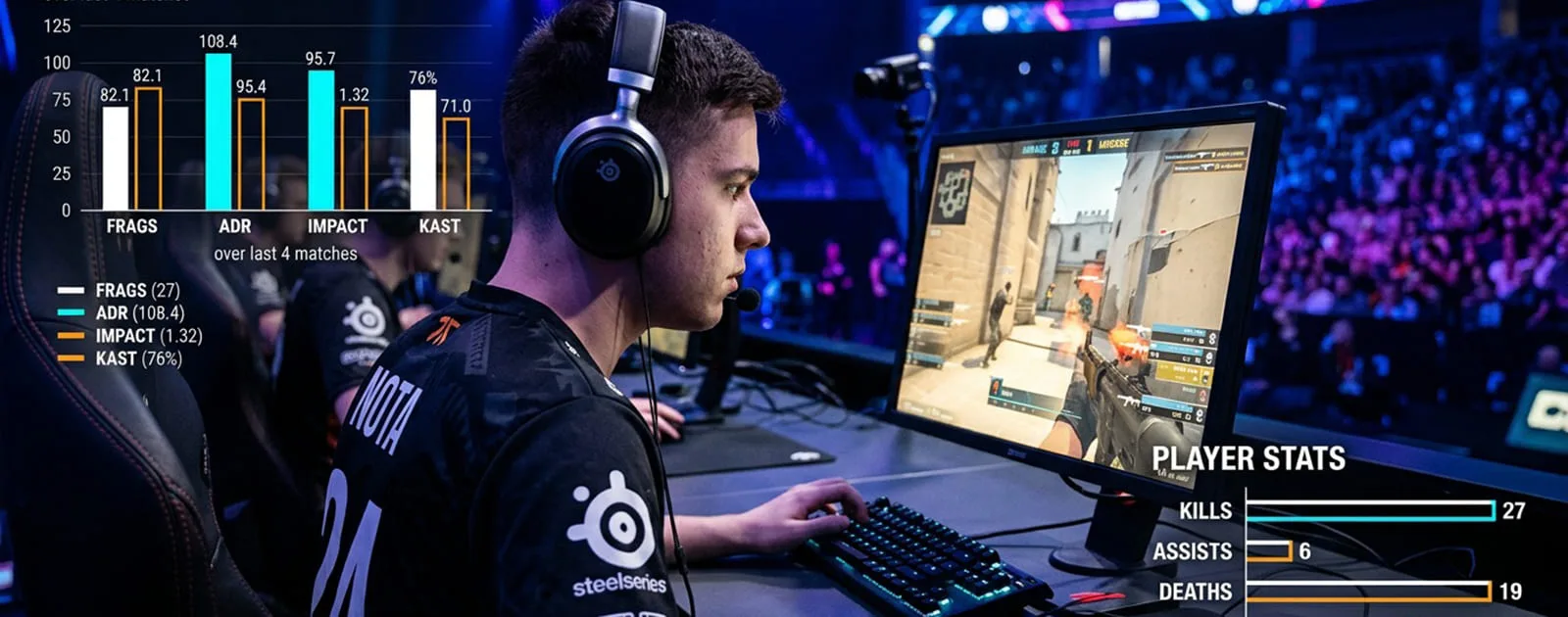
Just a few years ago, understanding an esports match often required nothing more than the score on the screen and the commentators' explanations. Today, broadcasts have evolved into full-fledged analytical products, giving viewers access to map statistics, economy data, team history, and the current form of individual players.
Statistics have become more than just additional information—they help viewers better understand the logic behind team decisions and the flow of the game.
Analysis begins before the match even starts
Preparing for an esports match now often begins before the teams even enter the server. Just like in traditional sports, fans analyze previous results, team lineups, and the current form of each roster.
At the same time, esports has its own unique influencing factors. In Counter-Strike 2, important metrics include map statistics, map picks and bans, and team economy scenarios. In Dota 2, the current patch plays a major role—even a single balance change can completely reshape popular strategies and hero selections. In League of Legends, attention is often focused on early-game advantages, objective control, and gold differences at specific stages of the match.
The scoreboard no longer tells the whole story
The score alone does not always reflect the true state of a match. For example, in CS2, a team may be behind in rounds while still having a stronger economy and better conditions for the next round.
In Dota 2, having more kills does not guarantee map control, as positioning, resources, and territorial control can be far more decisive.
That is why live statistics are increasingly used during broadcasts:
- win rates on specific maps;
- number of first kills and trade efficiency;
- team economy;
- hero or champion selections;
- individual player form.
These statistics do not replace the game itself, but they provide valuable context. Viewers gain a better understanding of why a team changed its pace, gave up a position, or made a risky move.
The Ukrainian esports audience is evolving as well
As analytical coverage continues to develop, the Ukrainian-speaking esports audience is also growing. More broadcasts are focusing not only on emotions but also on explaining key in-game moments.
Commentators increasingly break down round economy, patch changes, and strategic decisions. As a result, matches become easier to understand even for viewers with limited playing experience.
Watching has become interactive
The modern esports fan rarely watches a match without additional resources. Statistical websites, social media, and live chat are often open at the same time.
Viewers compare pre-match predictions with what actually happens in the game, discuss map selections, and analyze whether team decisions proved successful.
Statistics have become part of the viewing culture itself, creating additional discussion around every match.
Numbers add depth to emotions
The greatest value of statistics comes when they explain specific moments. Why did a team make a partial buy? Why did it give up the first objective? Why did the opponent ban that particular map?
These details allow viewers to see the game from a broader perspective.
Esports has remained fast, dynamic, and emotional, but it is now watched with a much deeper understanding. While the scoreboard once showed only the final result, modern analytics help explain the path that led teams to that outcome.